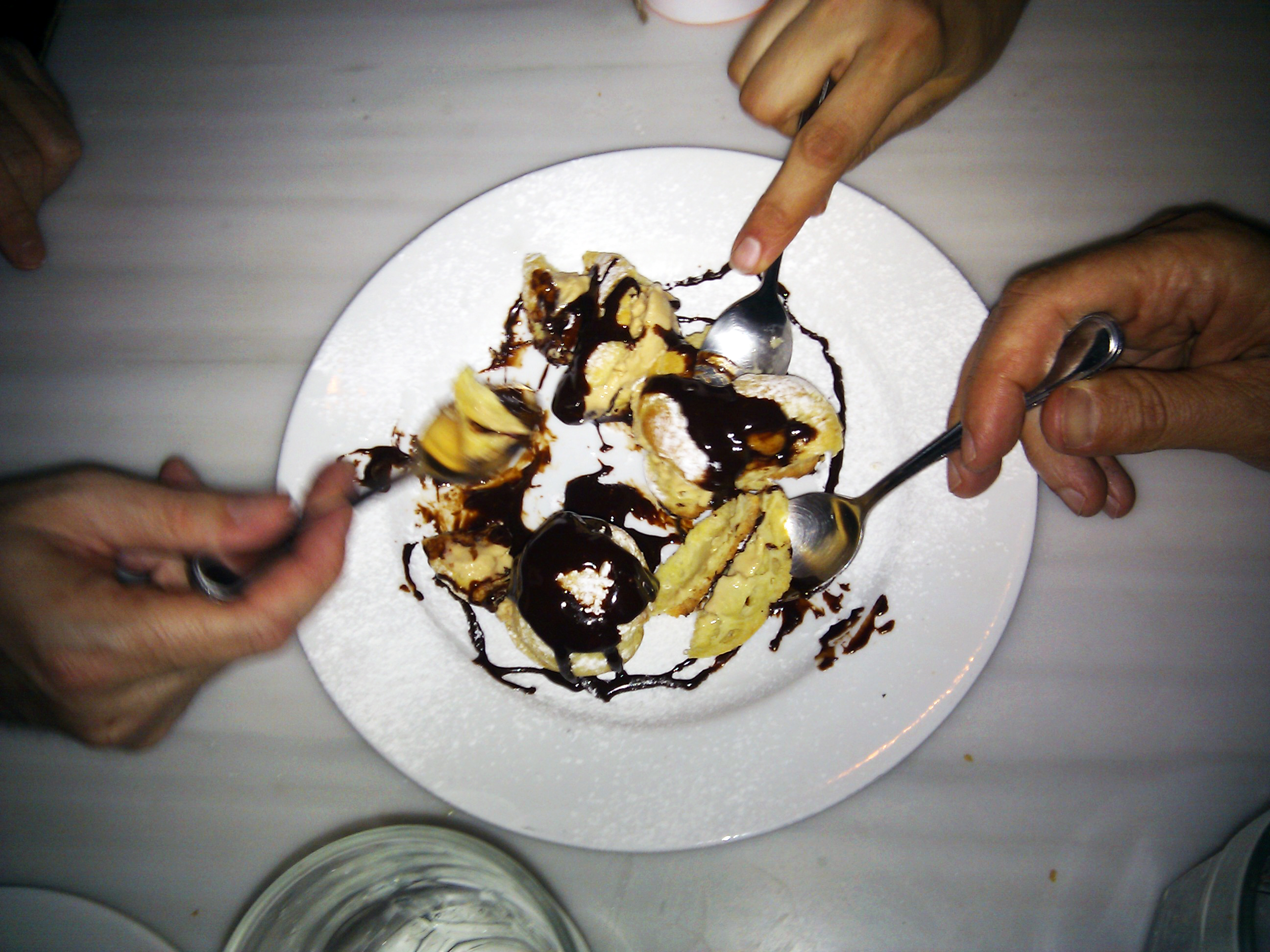
I’ve had to brush up on my Catholic liturgy today by calling mi abuelita and having her explain to me the significance of Domingo De Ramos or Palm Sunday. She tells me that Holy Week begins with Palm Sunday of the Lord’s Passion, which is really the triumph of Christ as Messiah as he rides into Jerusalem through the ritual of the procession of the palms by the Catholics, and the announcement of the passion in a Mass narrative. Some drama happens when Christ sees all the folks selling outside the church (ah-hem, not like something like that would happen outside La Merced church in La Antigua).
People carry palms and bouquets which are blessed objects consisting of palmas y ramas de olivo o laurel. La Antigua was full of them, all shapes and sizes sitting right next to the mango on a stick saleswoman. This Sunday definitely had the twofold aspect of both the glory and suffering, not just on Christ’s face as he was marched from La Merced church and back, but on the poor clean-up crew’s face as they swept up all the alfombras trampled on by the float carriers.
We’re days away from Holy Thursday, right outside Lent, and then it’s full steam ahead into resurrection Sunday. We won’t be spending too much money on gas this week because after Wednesday the streets of LAG are filled with Semana Santa revelers!
For a Saturday the town was quiet with the silence of anticipation. Cuaresma is reaching its climax in La Antigua and sometimes a pillow fight in the middle of Parque Central is exactly what you need.
In Tecun Uman the streets are like a Pac-Man game, sometimes they wind in impossible turns around the main square and sometimes they just end onto a dirt path and on the other side is the border. We follow the trail of cars that bleed quickly into Tecun Uman’s now paved roads that I remember so distinctly were dirt roads that would form large mounds of mud along the houses when it rained. There is a main square that the road leads us around and on the outskirts is the SAT office, large, desolate and surrounded by men sitting at old typewriters busily pounding at rusty keys as you enter through the side. It is an inferno outside and inside it is a stuffy cave with people using their documents to fan themselves. There is only SAT person at the front desk and as if he’s been waiting for us all morning, he smiles and asks how he can help us. I take a seat at let Brad do his thing. He’s doing well, until, the new SAT guy says: “There a law that states you can’t bring the car back until 90 days from the point you exit the country.” I interject and ask him if there’s a way to get an exception made. He thinks to himself and says, “Possibly, but you would need to talk to Berta. She’s on the other side of the railroad tracks at the big SAT office.” It sounds ominous. Brad is looking defeated. He zips his black binder with all our paperwork and drags himself to the car. “Let’s go,” he says, “back home.” At that moment a tracker, a guy who’d been listening all along to our SAT conversation, offers to take us to Berta for Q100. I tell him that’s too much, Brad gets in the car. Q50 he says. Q50 and what? I ask. Q50 and I lead you to her in your car. Brad understands and says NO WAY! Q50 and you take a motorcycle, I tell him. That’s fine, follow me, then, he says.
Brad is suspicious. I tell the tracker he has 2 minutes to get a motorcycle, get on it and lead us to Berta. Within two minutes we’re following him out of Tecun Uman, past the snake line of tractor trailers waiting for inspections and to a large SAT office that sits like a mansion at the end of the dirt road. The parking lines are even painted outside the entrance of the building and inside there are two plasma screens with cable tv. While Brad talks to Berta, I talk to the car inspectors, tax collectors and everyone in the waiting room. I find out from Saul at 7943-8163 that our car is not worth much but the taxes are Q10,000 so we don’t ever have to go through this process again. It would take two hours, he tells me. I say, Saul, our car is valued at $3,700, do you think it makes sense to make more than $1,000 on it in taxes? I see your point, seño, he tells me. As I’m wheeling and dealing, Brad calls me into Berta’s office. “Please confirm what she said,” he whispers in my ear.
“We are making an exception for you,” Berta, the young thirty-something equivalent of the Talisman grim reaper from yesterday, is amused by Brad and just gives a lackluster smile when I translate what she says to Brad. “I have called the SAT person at the border and all you have to do is stay out of the country for one day. These things rarely happen, so please don’t make it a habit.” We shake hands and get out of there fast, make our way back into Tecun Uman and over the Mexico border. Next stop Tapachula, oh, lovely Tapachula with a city grid, well-paved wide roads, trash cans on street corners and women who wear shorts, here we come. One hour later we are sitting by a pool in Casa Mexicana and wondering where it all went wrong.
The road to Tecun Uman and El Carmen is lined by green forest, sloping pastures with grazing cows and purple lilacs falling gently on the pocket-marked pavement ridden with potholes and speeding tractor trailers headed to Mexico. Cars create their own third lane as they pass other cars and the speed bumps are sudden and unmarked, as random as the towns that have formed facing the road, the CA-2 that leads towards the border. People have formed entire lives facing this street – vendors extend their arms to sell by the speed bumps, women in short skirts holding small handbags stand demurely by the side of the road and small children and thin dogs quickly run across before the next passing car.
I haven’t been on this road since we were headed North, towards Juarez, to illegally cross the Mexican border with the United States when I was six years old. The road was an endless stretch of black ocean that swallowed the lights from the Pullman we rode on. I held mi mama’s hand tighter and slowly we made our way up and up, jumping on the next bus, truck, car, anything that came our way. We were a long way from home and my mother thought she had taken me out of this place for good, right before the height of the massacres in 1983.
Twenty-six years later, I’m laying down new tracks, nuevas pistas, new memories to be reminisced as they happen on our most mundane task of renewing our visas and our car permit, every 90 days, and one can’t even begin to imagine what Migracion or the SAT (the Guatemalan version of the DMV) will come up with to make our crossing over to Mexico a web of intricate details that must be negotiated with the exact words, tone and deference, not laws, but attitude.
The odds are for us because we have two borders, Tecun Uman and Talisman at El Carmen, to negotiate the conditions of renewing our visas and car permits should we strike out on the first border. We have a big black folder read with: copies of our title, our passports, our car registration, our previous two car permits, our licenses, official letters from the Embassy stating the purpose for my visit to Guatemala, Brad’s got his best gringo smile on and I’m ready to listen and ask less questions. Easy enough, since all our paperwork is completely legit and official. The only sticking points are:
(1) The car permit needs to be renewed at a border that is not the Central American States. Meaning: Mexico, Belize, Costa Rica. However, when we drove to Aguas Calientes in December, the border with Honduras right past Esquipulas, we had no problems renewing our permit. We’re at the Mexican border so we have this requirement covered.
(2) Likewise with the passport Visas.The Visas need to be renewed at a border that is not the Central American States. There is a fine incurred if you return earlier than the 72 hours. There is also a fine incurred if you are only one day before your Visa expires because it takes two days to process, so by the time your Visa processes you will be over your expiration date, so you have to pay the $50 to renew. We’re good on this one because everything expires on March 22 for us and so we’re ahead of the game. So we think.
(3) We are supposed to take the car out of the country for 72 hours, have the Guatemalan permit cancelled before we enter the new country and then a new permit will be issued when we return. The 72 hours is negotiable based on the official that is at the SAT and I have yet to get a clear reply about what the law actually states from any of the SAT folks I have spoken to at the border. So this gray zone is the one we’re most worried about.
We opt for El Carmen because Tecun Uman is sketch and has a reputation. We’ve also had friends recommend it us. What does mi mama have to say about it? “Las dos fronteras no sirven.” Both borders are no good. So we push our luck and try to be patient with the 30 KM of endless tumulos, speed bumps, that make our drive to El Carmen more like an hour and a half. As we approach El Carmen it’s a descent down into the town and then suddenly it’s the market, the zizagging bodies between cars, black smoke, dust, honking from trucks, men flashing large wads of money at your car window, raw sausages dangling from street carts, and then the pale green of the SAT and immigration building. We roll on by SAT because there’s no sign and straight to immigration to get our passports stamped. The immigration office is curious about this Guatemalan with a US passport and this gringo from St. Louis with a car with California plates going into Mexico for the day just to eat huaraches and renew their Visa and permits. They smile and send us back to SAT. We take a breath when we’re sent back and try to not roll over any pedestrians, dogs or children as we drive back up the hill.
We pull up to the SAT office and put our hazards on. It can’t possibly take that long. Inside it beings. The first SAT person ask for our permits, our passports, how long we’ve lived here, for how much longer, what is our employment and when are we returning. I tell him we’re working in Guatemala, I have a fellowship and we are here at least until October 2010. He asks to see the letter that details my employment and fellowship. I show it to him. He reads it and nods as he reads it. Then he says:
“You do know that there’s a law that states that once you take your car out of Guatemala and cancel the permit, that you can’t bring it back in for another 90 days?” No, I tell him. I know there’s a law that states we need to keep it out of the country for 72 hours before returning the car into the country. “No,” he says adamantly, “it’s 90 days.”
That’s a bit problematic I tell him because I have to be back in La Antigua by Sunday night in order to catch a plane on Monday. “You’ll have to do that without your car,” he tells us flatly.
“It’s interesting,” I tell him, “because we need our car to be able to do our work. What do we need to do to resolve this situation? We understand there may be additional costs and inconvenience fees. We’re really just trying to do the simple thing of renewing our car permit and getting back to our home to do our work.”
“I’m sorry,” he says, “I do not have the authority to let you do that.” Then who does? I ask. He asks me to wait a moment and goes back into some hidden office to speak to his boss. He returns 15 minutes later. “My boss says he does not have the time to speak to you.” He restates the situation and the impossibility of resolving the situation. I ask him to kindly show me a copy of the law he is referring to, he scrambles to find it and is not successful. I am getting flustered.
“Since you don’t have the authority to approve our request for an exception we’re really just wasting each other’s time here, you’re the messenger,” I try to say calmly. “With all due respect, can you please persuade your boss to speak to us? We’ve travelled a long way and it won’t take long for us to speak about our situation with him.” He looks me straight in the eye, not a single emotion behind it. He lowers his head, “Va, I will try again.” He goes back and disappears for another 15 minutes. This time he opens the bullet-proof door to the inside of the SAT office and says, “My boss will see you now.”
I follow him with Brad and then I see his boss, short, Soprano-like, with a suit and tie, sweating and not happy to see me at all.
“I am a very busy man, ma’am, and I just kicked out two very important people out of my office in order to speak to you. What exactly do you want?”
“Good morning, sir,” I say to him, “I appreciate you taking the time to speak to us. Our situation is very simple. I have a fellowship to work here, I’m a US citizen although I’m from Guatemala, my husband is also from the US and we need our car to do our work. We cannot afford to not have our car for 90 days. It will affect our ability to work. We ask for an exception because it’s also been very confusing – all the other borders we’ve been to we’ve been informed it’s 72 hours to keep the car out of Guatemala.So have other people we’ve know to renew their car permits. We’re both educated, law-abiding folks and it’s impossible to figure out your SAT laws and untangle the mess of contradictory information.”
“You say you’re licensiada with a Master’s, where exactly did you get your Master’s from?” I tell him UC Berkeley. “Do you have the diploma to prove that? He asks. I tell him that in fact, yes, I do. I have it just in case I meet inquiring minds like his. So I pull out my Bachelor’s and Master’s degree original copies. He reads both of them, even though one of them is in Latin. He doesn’t miss a beat. “I have a Master’s as well from Guatemala and it’s the equivalent of yours.” I’m confused, I tell him, what does this have to do with our car permit?
“Well,” he says, “it has to do with your car permit because I wanted you to know that even though you come in here with your certificates, US passports, letters and whatever else you brought, you are not above the law and the laws says 90 days.” Where and which law, please show me, I ask him, my voice pitch is rising and I don’t like it. He shows me the “Anexo de la Resolucion No.223-2008 [COMIECO-XLIX], Código Aduanero Uniforme CentroAmericano – CAUCA and RECAUCA.” The part that concerns us most is most is Articulo 442 which states “No podrá otogarse una nueva autorización de importación temporal de un vehiculo hasta que transcurra un plazo de tres meses desde su salida del territorio sin que se haya operado la suspensión del plazo o de su depósito bajo control aduanero.”
Yep, three months. He’s right. And we had no clue about this law. I ask him if he can kindly make me a copy so I can use it for informing others. “Gladly,” he says and calls in the original person we spoke to to make copies. “For this reason I cannot grant you an exception. You are not above the law. Now if you can leave my office, I have other important business to attend to.” The messenger whispers to me, “It did not go well?” No, I tell him, perhaps the heat is getting to us all. He gives me the copy of the law and I thank him for his patience.
When we step out to the where our car is parked with its hazards still blinking after an hour of being in there, Brad and I decide that it’s time for Plan B. So we park the car, walk across the border to the Mexico side and renew our permits. Not a huarache or taco stand in sight, we head back, get in the car and make the hour and a half drive back to Retalhuleu in the dark. It feels like a death march and in our surrender drive we decide tomorrow we need to do this again, but this time, it’ll be Tecun Uman – seedy, chaotic and everything a border town should be.